
New CTIC Executive Director Mike Komp Takes the Helm
CTIC News
WEST LAFAYETTE, Indiana (April 24, 2019)—The Conservation Technology Information Center (CTIC) welcomes its new Executive Director, Mike Komp. The role will call upon Komp's skills to build collaborative networks that help promote and champion conservation farming systems, secure funding for new programs, and—increasingly—help analyze and disseminate digital data on conservation practices.
As interest in sustainable farming practices grows among farmers, consumers, and policymakers, CTIC's role is expanding, noted Terry Tindall of J.R. Simplot, Chair of CTIC's Board of Directors. So is the role Komp has been selected to fill.
"Mike brings skills that reflect not only the legacy of CTIC but also the technical knowledge that will help guide our organization into the future," Tindall said.
"For nearly 40 years, CTIC has kept up with the latest technology to collect and disseminate information about conservation agriculture. Today, with projects like our new Operational Tillage Information System (OpTIS), remote sensing and big-data analysis are becoming central to our mission," Tindall added. "Mike brings his experience in those fields—and his program development skills—which will help farmers, consultants, researchers, conservation professionals, policy makers and so many more stakeholders put that information to work promoting farming systems that are economically and environmentally sustainable."
Komp was named to Oklahoma's NextGen Under 30 list in 2016 in recognition of his innovation and leadership. An expert in geographic information systems (GIS) and remote sensing, he most recently served as Technical Program Manager for Agricultural Technology at the Noble Research Institute. The role included collaborating with academic researchers, government agencies, farm groups, consumer products companies and others.
His work experience with Noble Research Institute and with a contractor for the National Parks Service includes hands-on natural resource condition assessments in national parks and rangeland as well as program development and coalition building around agricultural technology.
Komp, who holds master's degrees in geographic information science and business administration, says the information CTIC gathers and shares is increasingly vital not just within agriculture, but throughout the entire value chain linking farmers to consumers.
"Fundamentally, conservation starts on the ground with the folks engaged in agriculture and natural resources, especially farmers and ranchers," Komp said. "CTIC plays an important role in transferring technology and research into application within the economy. We can bridge the critical gap between science, innovative technology, and industry to increase consumer confidence in agriculture and enhance our natural resource base for generations to come."
# # #
The Conservation Technology Information Center (CTIC) is a national public-private partnership that includes farmers, policy makers, regulators, academic researchers, agribusiness leaders, conservation group personnel, farm media and others. CTIC connects, champions and provides information on sustainable agricultural systems and technologies that are productive, profitable and preserve natural resources. CTIC is supported in part by the U.S. Environmental Protection Agency, USDA Natural Resources Conservation Service, and other public entities.
Categories

Sign up for our Newsletter
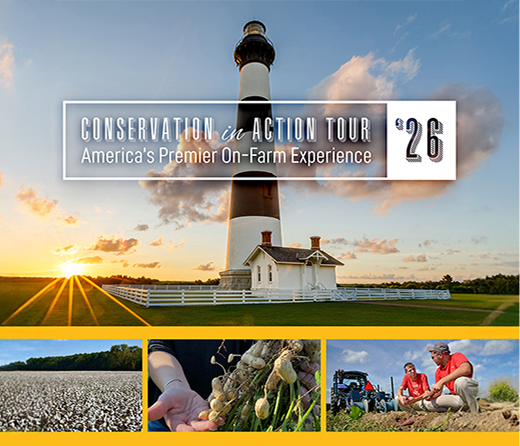
June 2026 | Raleigh, North Carolina
Conservation in Action Tour | America’s Premier On-Farm Experience
Related News
Indiana’s Farm Advisors Mentoring Program Flattens Learning Curve for Regenerative Agriculture
If someone asked you to name five winners from this year’s Winter Olympics, could you identify them? But if someone asked about your five favorite teachers from your entire school career, could you name them immediately? Our favorite teachers–and their lessons–stick with us. So do lessons from mentors. Farm Advisors in Indiana recognizes the importance…

CTIC, SARE, and USDA Unveil 2026 Cover Crop Report at Farm Progress Show; Publish Webinar and Presentation
Results of the 2026 National Cover Crop Report indicate strong interest in cover crops among many farmers who produce a wide range of crops and livestock. Among respondents to the national survey, the average acreage planted with cover crops was 397.9, and their projections anticipate crossing the 400-acre mark by next year, a 33% increase…

2026 National Cover Crop Report Shows Continued Expansion Of Cover Crop Use, Including Cover Crop Grazing, Use Of Drones, And Planting Patterns
Farmers with 10+ years of experience help provide insights into incentive program design, monetization, and management practices that drive returns on investment. INDIANAPOLIS — Results of the 2026 National Cover Crop Report released Sept. 1 at the Farm Progress Show indicate strong interest in cover crops among many farmers who produce a wide range of…