
CTIC To Lead Development of the CSA Connector for a New USDA Climate Smart Partnership Program
CTIC News
WEST LAFAYETTE, Indiana (September 22, 2022) — The Conservation Technology Information Center (CTIC), in partnership with The Nature Conservancy and Houston Engineering, will lead development of a new online tool, the Climate Smart Agriculture (CSA) Connector, as a key element of a new project selected last week for funding by the U.S. Department of Agriculture’s (USDA) Partnerships for Climate Smart Commodities program.
The overall project is being led by the Wolfe’s Neck Center for Agriculture and the Environment, which was awarded up to $35 million by USDA to conduct this new partnership pilot. Through their global collaborative, Open Technology Ecosystem for Agricultural Management (OpenTEAM), Wolfe’s Neck Center will lead an alliance of over 60 national and regional buyers, funders, and organizations to launch and support climate-smart agricultural pilot projects on farms and ranches in the Northeast, Mountain West, and California.
The CSA Connector is an app being developed by CTIC and its partners to play a key role in the program by connecting all of the relevant participants in the emerging climate smart commodity marketplace—buyers, producers, technical service providers, and certifiers–with each other and with the information needed to support transactions among them. Using the innovative OpenTEAM work environment, participants will have easy access to a wide range of resources, including environmental claims registries, calibration data sets, and other information libraries. OpenTEAM emphasizes integrability, interoperability, full transparency and accountability.
“We are honored to be part of the impressive team that Wolfe’s Neck Center has assembled to conduct this project. It represents an important first step in the larger global imperative to adapt our nation’s agri-food system to the challenges of climate change, and to also make tangible progress on the effort to bring carbon neutrality to all of society,” said Dr. Dave Gustafson, interim executive director at CTIC.
Dr. Gustafson also notes there are potential opportunities for the CSA Connector to contribute to the other pilot partnership projects just selected for funding by USDA. “We are excited about the numerous ways the CSA Connector could play a helpful role in many of the new efforts to pilot the new climate smart commodity concept. USDA is encouraging collaboration among the various pilots, and we look forward to doing our part.”
CTIC learned this good news just after celebrating its 40th Anniversary last week in St. Louis, while also conducting its 15th annual Conservation in Action Tour, which attracted a diverse group of nearly 150 participants including farmers, crop consultants, researchers, agribusiness leaders, conservation staffers, and policymakers. During the morning, attendees saw climate smart practices such as cover crops and conservation tillage at work in the field. Later, they moved indoors to the Donald Danforth Plant Science Center to hear from a number of experts about what the future will bring in several key climate smart areas: soil carbon technologies, data science, remote sensing, and advanced nutrient technologies.
About the Conservation Technology Information Center
The Conservation Technology Information Center (CTIC) was formed in 1982 to support the widespread use of economically and environmentally beneficial agricultural systems. Members of CTIC, a non-profit 501(c)(3) organization, include farmers, policy makers, regulators, academic researchers, agribusiness leaders, conservation group personnel, farm media, and others. The organization is supported by the U.S. Environmental Protection Agency, USDA Natural Resources Conservation Service, and other public entities. CTIC’s mission is to champion, promote and provide information on climate smart technologies and sustainable agricultural systems that conserve and enhance soil, water, air and wildlife resources and are productive and profitable. Learn more about CTIC at www.ctic.org.
About Wolfe’s Neck Center for Agriculture and the Environment
Wolfe's Neck Center is a nonprofit, farm-based education, research, and visitor center on a mission to transform our relationship with food and farming for a healthier planet. By facilitating knowledge and best practice sharing, educating a wide variety of learners, and convening a community of people who care about the future of food and the planet, Wolfe's Neck Center aims to help make agriculture a solution to climate change. To learn more about Wolfe’s Neck Center, click here.
Led by Wolfe’s Neck Center, Open Technology Ecosystem for Agricultural Management (OpenTEAM), is a farmer-driven, collaborative community committed to improving soil health and advancing agriculture’s ability to become a solution to climate change through the codevelopment of an interoperable suite of tools. By acting as a convener, technology steward, and facilitator, OpenTEAM is increasing the integrity, interoperability, and knowledge shared across the agricultural technology landscape for a more sustainable technology ecosystem. To learn more about OpenTEAM, click here.
Categories

Sign up for our Newsletter
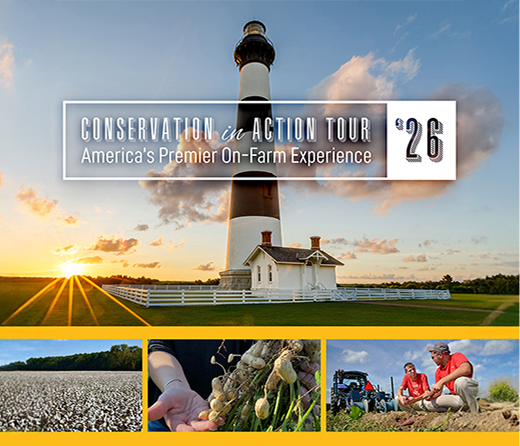
June 2026 | Raleigh, North Carolina
Conservation in Action Tour | America’s Premier On-Farm Experience
Related News
Indiana’s Farm Advisors Mentoring Program Flattens Learning Curve for Regenerative Agriculture
If someone asked you to name five winners from this year’s Winter Olympics, could you identify them? But if someone asked about your five favorite teachers from your entire school career, could you name them immediately? Our favorite teachers–and their lessons–stick with us. So do lessons from mentors. Farm Advisors in Indiana recognizes the importance…

CTIC, SARE, and USDA Unveil 2026 Cover Crop Report at Farm Progress Show; Publish Webinar and Presentation
Results of the 2026 National Cover Crop Report indicate strong interest in cover crops among many farmers who produce a wide range of crops and livestock. Among respondents to the national survey, the average acreage planted with cover crops was 397.9, and their projections anticipate crossing the 400-acre mark by next year, a 33% increase…

2026 National Cover Crop Report Shows Continued Expansion Of Cover Crop Use, Including Cover Crop Grazing, Use Of Drones, And Planting Patterns
Farmers with 10+ years of experience help provide insights into incentive program design, monetization, and management practices that drive returns on investment. INDIANAPOLIS — Results of the 2026 National Cover Crop Report released Sept. 1 at the Farm Progress Show indicate strong interest in cover crops among many farmers who produce a wide range of…