
About
Project: Indian Creek Watershed

Facilitated by CTIC, local farmers and interested others lead this project to demonstrate and test best conservation practices on Indian Creek Watershed farms.
The project, sponsored by the Illinois Environmental Protection Agency (with funds provided through Section 319 of the Clean Water Act) will show how conservation practices installed on Indian Creek watershed farms will affect water quality.
Goal
Determine what water quality improvements result when 50-75% of producers and acres in a small watershed adopt comprehensive agriculture conservation systems over a six-year period.
Activities
- Outreach activities include field tours, public meetings, email and website updates, news releases and more.
- On-farm demonstrations showcase the latest products, techniques, equipment and tools for resource conservation.With funding from USDA, CTIC will employ tile outlet monitoring to measure water quality.
- CTIC and Livingston SWCD partner with Argonne National Laboratories to study the growth and water quality effects of bio-energy crops in the Indian Creek watershed.
- Through a USDA Mississippi River Basin Initiative grant, USDA-NRCS and Livingston County SWCD provide financial assistance to farmers implementing best resource management practices.
- Every farmer in the watershed will be contacted to implement conservation practices/systems.
Illinois native Dr. Harold F. Reetz, Jr. leads design and oversight of demonstration and testing plots. These will measure the effectiveness of how farmers manage fertilizer and manure and will demonstrate systems of best management practices for reducing negative effects on water quality in Indian Creek and downstream.
Indian Creek Watershed
The 82-square mile drainage area (52,480 acres) of Indian Creek Watershed flows to the South Fork of the Vermilion River, one of USDA’s Mississippi River Basin Initiative focus areas.
Agriculture dominates the watershed – 95 percent of the land is tillable, most in a corn/soybean rotation, although there are numerous livestock operations. The average farm size is 500 acres.
The City of Fairbury, the only urban population within the watershed, consists of approximately 4,000 people.
The major resource concern for Indian Creek watershed is water quality, particularly nitrate levels. Located in the southern portion of Livingston County, the watershed drains northward to the Vermilion River and the cities of Pontiac and Streator.For more information about the project, contact Chad Watts, CTIC project director, at [email protected].
Current Projects
Past Projects

Sign up for our Newsletter
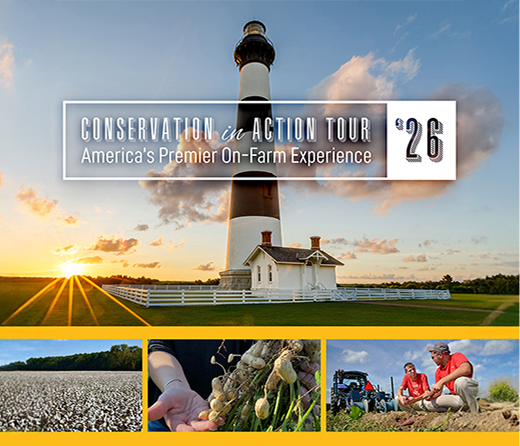
June 2026 | Raleigh, North Carolina
Conservation in Action Tour | America’s Premier On-Farm Experience
Related News

Systems Working for the Soil: Z3 Agriculture, Conservation in Action Tour Farm Stop Host
Zeb Winslow’s experience in timing and asset utilization drives not only his farm and equipment decisions, but it also drives his soil decisions.
“The most expensive thing that you will rent or buy over the course of your farming career is sitting dormant for 75-80 percent of the year,” Winslow says. “It should be doing something. The soils weren’t designed to lay empty for that amount of time.”

Speakers and Stations Added for Conservation in Action Tour
Regenerative farmers to provide perspectives on circular production systems that scale. This year’s Conservation in Action Tour will feature 10+ innovative farmers, each presenting their own station to broaden perspectives for attendees interested in diverse rotations, profitability of conservation practices, market development opportunities, conservation financing, nutrient management, technology, and data benchmarking and monetization. The 19th annual…

Farm Stops Set for Conservation in Action Tour
Attendees will take a deep dive into the data and technical assistance driving North Carolina’s diverse rotations and cropping systems that include cotton, soybeans, corn, tobacco, strawberries, sweet potatoes, peanuts, and watermelon. Innovation, profitability, and technology in conservation agriculture will take center stage during the 19th annual Conservation in Action Tour June 3-4 in and around Raleigh, N.C. …