
National Aquatic Resource Survey
Project

The National Aquatic Resource Surveys (NARS) are collaborative programs between the U.S. Environmental Protection Agency (EPA), states and tribes that assess the quality of the nation’s inland and coastal waters, providing vital data that can help guide conservation efforts on the landscape.
CTIC works with EPA and its partners on technical training to carry out NARS assessments, and to promote conservation systems that help protect and improve water quality.
Through articles, videos and other media, we hope to inform farmers and landowners about water quality issues, inspire them to adopt practices that help address those challenges, and show their neighbors the steps that these dedicated stewards are taking to protect and improve our nation’s water resources.
Anthony Beery
Location Mt. Crawford, VA Documents Beery: Build Soil to Be Able to Build Farm for the Long Term, Delmarva Farmer,…
Terry Lenssen
Location Lyden, WA Images
Buff Showalter
Location Dayton, VA Documents Conservation Buff: Conservation Practices Positively Impact Bottom Line, Delmarva Farmer, May 16, 2017 Videos Images
Corey Leis
Location Cashton, WI Documents No-tilling alfalfa into rye improves erosion control, Wisconsin Agriculturist, November 2, 2018 Images
Andy Shireman
Location Chapin, IL Documents No-tilling alfalfa into rye improves erosion control, Prairie Farmer, October 31, 2018 Images
Current Projects
Past Projects

Sign up for our Newsletter
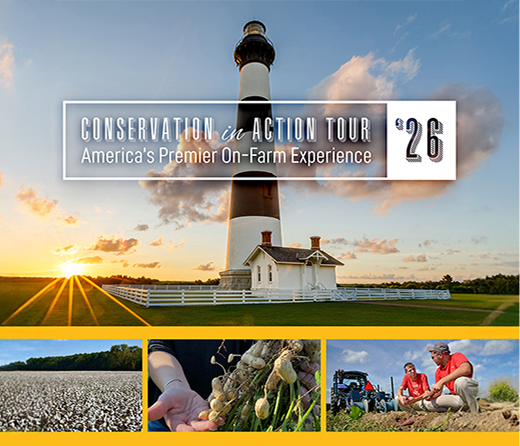
June 2026 | Raleigh, North Carolina
Conservation in Action Tour | America’s Premier On-Farm Experience
Related News

Speakers and Stations Added for Conservation in Action Tour
Regenerative farmers to provide perspectives on circular production systems that scale. This year’s Conservation in Action Tour will feature 10+ innovative farmers, each presenting their own station to broaden perspectives for attendees interested in diverse rotations, profitability of conservation practices, market development opportunities, conservation financing, nutrient management, technology, and data benchmarking and monetization. The 19th annual…

Farm Stops Set for Conservation in Action Tour
Attendees will take a deep dive into the data and technical assistance driving North Carolina’s diverse rotations and cropping systems that include cotton, soybeans, corn, tobacco, strawberries, sweet potatoes, peanuts, and watermelon. Innovation, profitability, and technology in conservation agriculture will take center stage during the 19th annual Conservation in Action Tour June 3-4 in and around Raleigh, N.C. …

Farmer Feedback Needed for the National Cover Crop Survey
Farmers across the U.S.—whether they use cover crops, formerly used them, or have never planted covers—are invited to share their insights on cover crops in the National Cover Crop Survey being conducted by the Conservation Technology Information Center (CTIC), the USDA’s Sustainable Agriculture Research and Education (SARE) Program, and the American Seed Trade Association (ASTA).…