
Demonstrations
Project: Indian Creek Watershed

Our demonstrations illustrate the 4 Rs of nutrient management:
- Right Source
- Right Rate
- Right Place
- Right Time
We demonstrate management systems—not individual practices.
We measure practice success through agronomic yield, economic sustainability, nutrient use efficiency and water quality impacts.
Agrium’s ESN® v. Urea
Agrium designed ESN®, a polymer coated urea, to slow the release of nitrogen into the environment. This is allows the plant to access nitrogen when it needs it the most.
ESN® yielded the highest in all of the trials. The maximum economic rate of nitrogen (MERN) was also higher probably due to ESN®’s ability to slowly release nitrogen to the crop and continue providing yield-increasing nitrogen throughout the growing season.
Take Home Lessons:
- ESN® showed higher yield over spring urea.
- MERN rate was higher with ESN® than urea.
- Using ESN® in combination with other nitrogen sources or as split application may yield even more.
Resource:
Application Timing
We designed this study to demonstrate the differences in nitrogen rates and yields with different urea application times.
Spring timing gave the best return to nitrogen dollars spent. Fall had the worst return and lowest yield. 2011 weather patterns favored spring application. Conditions resulted in especially high potential nitrogen losses during the winter and early spring.
Take Home Lessons:
- Spring nitrogen application resulted in the highest yields.
- Spring timing delivered the most efficient in nitrogen use.
- Fall timing afforded lower maximum economic rate of nitrogen (MERN) due to N losses reducing efficiency
- Fall application returned lowest yield
- Split application timing (1/2 in fall and 1/2 in spring) yielded better than fall application, but not as well as spring application.
Resources:
Nitrogen Application Timing
Select the Right Time for nitrogen application.
Apply the Right Rate of fertilizer to meet crop needs.
Costs of inputs make it important to provide enough N so the crop is never deficient. For greatest efficiency, N should be applied close to the time it will be used by the crop.
This demonstration compares 3 different application times:
- Fall Application
- Spring Application
- Split Application—½ applied in Fall and ½ applied in Spring
A second demonstration compares the full recommended N rate with a reduced rate (85% of recommended rate) using a controlled-release source, ESN®.
ESN® controlled-release technology delivers N to the crop all season long, not just when it’s applied, allowing the crop to reach full genetic potential. The unique polymer coating helps prevent against all forms of N loss, including volatilization, denitrification, and leaching.
When used correctly, ESN® can substantially reduce N losses to surface water, subsurface drainage water, and groundwater, a positive impact to water quality.
Sidedress Phosphorus + MicroEssentials
Keep nutrients in the Right Place, where crops can use them.
A soil test showed a relatively low phosphorus level, so we selected a demonstration of Mosaic’s Micro-Essentials (MESZ) applied as a side-dress (plant nutrients placed on or in the soil near the roots of a growing crop) treatment to provide an additional boost in available phosphorus.
MESZ allows uniform nutrient distribution and provides essential nutrients crops need in one granule. It has two forms of sulfur for season-long nutrition.
MESZ allows uniform nutrient distribution and provides essential nutrients crops need in one granule. It has two forms of sulfur for season-long nutrition.
Operation
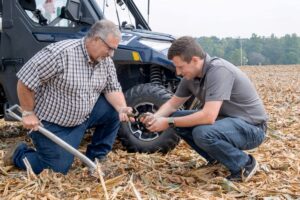
Herb and Aaron Steffen, of Cropsey, Ill., operate a 900 acre grain farm in southern Livingston and northern Mclean counties. Two thirds of the acreage is devoted to continuous corn with one third in a corn/soybean rotation.
Minimum tillage practices are used to leave at least 30% residue on the soil surface.
Nitrogen is applied after the corn has emerged, and when the plant needs are the greatest, to minimize loss of nitrogen through leaching.
Currently there are three test plots on the Steffen farm.
Resource:
Slow Release Fertilizer
Herb and Aaron Steffen manage a 900-acre grain farm in southern Livingston and northern McLean counties. They hosted a demonstration and two nutrient use efficiency (NUE) trials.
The Steffens plant corn continuously on two-thirds of the acres and rotate planting of corn and soybeans on the rest of the land. Their minimum tillage practices leave at least 30% of the previous crops’ residue on the soil surface. This residue decreases soil erosion and feeds nutrients back to the soil.
They apply nitrogen after the corn plants emerge, when nutrient needs are the greatest. This minimizes nitrogen lost to air and water.
To maximize efficiency, farmers must select the right nutrient source. A controlled-release nitrogen source such as Koch Agronomic Service’s Agrotain® may offer benefits.
Agrotain® blocks the enzyme urease to prevent nitrogen loss, which begins the moment the farmer applies fertilizer or manure. Losses add up over time, decreasing profitability and increasing nitrogen’s potential to pollute. This product allows the crop to access the nitrogen it needs immediately, but controls losses in the first critical weeks after application.
This demonstration compared the effectiveness of urea verses Agrotain® at two different rates. It showed that Agrotain® increased yield by preventing some nitrogen loss.
However, harvest yield data showed that field moisture conditions more greatly influenced yield than the addition of nitrogen stabilizers.
Strip Tillage Fall Nitrogen Application
We designed this study to demonstrate differences in nitrogen rates and yields under the same nitrogen product, where the producer planted corn for two consecutive growing seasons.
We conducted this trial to:
- demonstrate strip till application of anhydrous ammonia, a proven conservation practice.
- demonstrate how the farmer can conduct his own on-farm NUE using field-scale equipment with minimal disruption of his normal field operations.
- show how RTK guidance and variable-rate application equipment can improve nitrogen application efficiency.
- show how RTK yield monitoring equipment works at harvest time.
- show how the farmer and his advisers can collect data and make management decisions during the winter months.
We set plot sizes to match the farmer’s equipment width, which allowed him to do all of the plot work needed for the demonstration.
We created a fertilizer application map for the whole field (below). Marked areas indicate replicated plot locations and their assigned application rate.
The farmer applied anhydrous ammonia fertilizer in the fall, in a strip-tilled area. He harvested the plots with his yield-monitor-equipped combine.
We analyzed his yield data along with fertilizer rate and other data including field observations and soil and plant analysis and we used the Crop Nutrient Response Tool* to determine the maximum economic rate of nitrogen: 212 pounds per acre.
We encourage other farmers in the watershed to adopt this approach to collecting information critical to making fully informed nitrogen management decisions.
Strip-till Nitrogen
Keep nutrients in the Right Place, where crops can use them.
The farmer uses real-time kinematic precision guidance to apply N fertilizer in fall or early spring in a closely-controlled location relative to where the seed will be sown.
Strip-till conservation systems use minimal tillage. They combine soil drying and warming benefits of conventional tillage and soil-protecting advantages of no-till by disturbing only the portion of soil that will contain the seed row.
Here we are using fall applied N with an RTK strip-till system and comparing it to a conventional chisel plow system.
A special feature at this site is the demonstration of N use efficiency (NUE) rate comparison, done with field-scale equipment, so that the farmer can apply the rate treatments and harvest the plots with conventional equipment without interrupting his normal production routine. This demonstrates a simple approach to on-farm research that every farmer can adopt.
Operation
The Traub farm is a multi-generational farm based in southern Livingston County, Ill. Since 1980, John and Bonnie have farmed with son John C. and his wife Diane. In 2008, son John Jacob Traub and his wife Kristin joined the operation.
The Traub’s grow corn, soybeans and specialty hybrid seed corn, as well as hybrid sunflowers. The operation includes over 4,000 acres and has grown steadily through teamwork and solid relationships.
Livingston County SWCD named the Traub’s Conservation Farm Family of 2010.
Conservation Systems
Strip-till corn and no-till beans in rotation cover the majority of our acres. A continuous corn system, matched with conservation mulch till and some strip-till, is used on our flatter and more productive farms or where manure is available for the fertility requirements.
SUPERU
SUPERU®, a urea based product, contains urease and denitrification inhibitors within the fertilizer granule.
Koch Agronomic Services created SUPERU® to increase crops’ nitrogen uptake and efficiency.
We designed this trial to determine the Most Economical Rate of Nitrogen (MERN) and to compare spring, surface applied urea verses spring applied SUPERU®.
SUPERU® showed the highest agronomic efficiency of all the products compared in our NUE trials.
When surface applied on no-till corn after corn, SUPERU®’s returned $106.00 more than the untreated urea.
Take Home Lessons
- In this demonstration, SUPERU® improved surface applied nitrogen uptake.
- Profits from nitrogen application increased by $106.00 with SUPERU®.
- SUPERU® improved economic yield.
- SUPERU® showed best agronomic efficiency of all products in trial.
Webinar: Engaging Non-operator Landowners in Conservation
PowerPoint slides from Jamie Ridgely, chief operating officer of Agren, Inc. and presenter of Aug. 29 WIIN webinar on “Engaging Non-operator Landowners in Conservation.”
Resource:
Current Projects
Past Projects

Sign up for our Newsletter

June 2026 | Raleigh, North Carolina
Conservation in Action Tour | America’s Premier On-Farm Experience
Related News
Indiana’s Farm Advisors Mentoring Program Flattens Learning Curve for Regenerative Agriculture
If someone asked you to name five winners from this year’s Winter Olympics, could you identify them? But if someone asked about your five favorite teachers from your entire school career, could you name them immediately? Our favorite teachers–and their lessons–stick with us. So do lessons from mentors. Farm Advisors in Indiana recognizes the importance…

CTIC Welcomes New Member Organizations
CTIC is proud to welcome four new member organizations to its growing roster of multidisciplinary stakeholders to support our shared mission of supporting farmers in their adoption and expansion of regenerative agricultural practices. Nuveen Natural Capital, Landoption, Terion AI, and Milborn Seeds have become first-time members of CTIC and are eligible for Board Director positions…

CTIC, SARE, and USDA Unveil 2026 Cover Crop Report at Farm Progress Show; Publish Webinar and Presentation
Results of the 2026 National Cover Crop Report indicate strong interest in cover crops among many farmers who produce a wide range of crops and livestock. Among respondents to the national survey, the average acreage planted with cover crops was 397.9, and their projections anticipate crossing the 400-acre mark by next year, a 33% increase…