
Farmer Feedback Needed for the National Cover Crop Survey
CTIC News

Farmers across the U.S.—whether they use cover crops, formerly used them, or have never planted covers—are invited to share their insights on cover crops in the National Cover Crop Survey being conducted by the Conservation Technology Information Center (CTIC), the USDA’s Sustainable Agriculture Research and Education (SARE) Program, and the American Seed Trade Association (ASTA). This is the eighth survey in the research series, which began in 2012.
The anonymous survey is available online and takes about 15 minutes to complete. Farmers who complete the survey can enter a drawing to win one of three $100 Visa gift cards.
“This year, we are equally interested in not only hearing from farmers who are actively using cover crops, but also from those who no longer use them and who have never planted them at all,” notes Ryan Heiniger, CTIC executive director and 4th generation Iowa farmer and cover crop user. “Additionally and new this year, we’ve added more questions about grazing livestock on cover crops to explore return on investment and the practice’s potential as a contributing solution to help rebuild the nation’s cattle herds.”
Dr. Rob Myers, a University of Missouri professor and regional director of the North Central Region SARE Project, adds that information from the surveys has powerful impact.
“The National Cover Crop Survey is a tool that helps policy makers, agribusiness, commodity organizations, cover crop advocates, farmers and others understand how farmers think about cover crops and make decisions around adopting the practice,” Myers notes. “Previous surveys have been used in Congressional testimony, cited in academic research, used by educators to help share information to help farmers succeed with cover crops, and more.”
Andy LaVigne, president and CEO of ASTA, adds that the CTIC/SARE/ASTA cover crop surveys help seed companies predict market demand for cover crop seed and spot trends in the use of various cover crop species. That helps seed growers supply the steadily evolving market for cover crop seed.
“Understanding the demand and opportunities in the field helps seed companies keep in step with the market,” LaVigne notes. “Over the years, we have seen new species and varieties of cover crops come into the market, and we have identified trends in how farmers have used various cover crops to achieve a wide range of benefits.”
The 2025-2026 National Cover Crop Survey is open until March 31. Visit the CTIC website to view reports from past surveys.
Categories

Sign up for our Newsletter
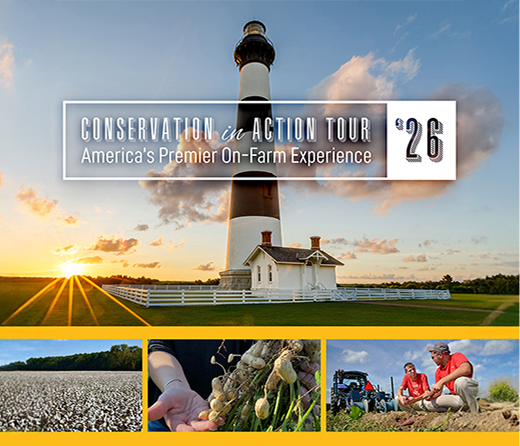
June 2026 | Raleigh, North Carolina
Conservation in Action Tour | America’s Premier On-Farm Experience
Related News

Speakers and Stations Added for Conservation in Action Tour
Regenerative farmers to provide perspectives on circular production systems that scale. This year’s Conservation in Action Tour will feature 10+ innovative farmers, each presenting their own station to broaden perspectives for attendees interested in diverse rotations, profitability of conservation practices, market development opportunities, conservation financing, nutrient management, technology, and data benchmarking and monetization. The 19th annual…

Farm Stops Set for Conservation in Action Tour
Attendees will take a deep dive into the data and technical assistance driving North Carolina’s diverse rotations and cropping systems that include cotton, soybeans, corn, tobacco, strawberries, sweet potatoes, peanuts, and watermelon. Innovation, profitability, and technology in conservation agriculture will take center stage during the 19th annual Conservation in Action Tour June 3-4 in and around Raleigh, N.C. …

RFP Open Through April 8 for Cover Crop Enrollment Partnership Program
CTIC is seeking partners capable of providing targeted, network-based engagement that identifies, qualifies, and connects high-quality farmer prospects for enrollment in the Farmers for Soil Health program. The Conservation Technology Information Center (CTIC) is seeking proposals from qualified vendors to participate in its Cover Crop Enrollment Partnership Program. Through this program, CTIC aims to collaborate…