
CTIC Embraces “Farming Weird” at Indiana Field Day
CTIC News


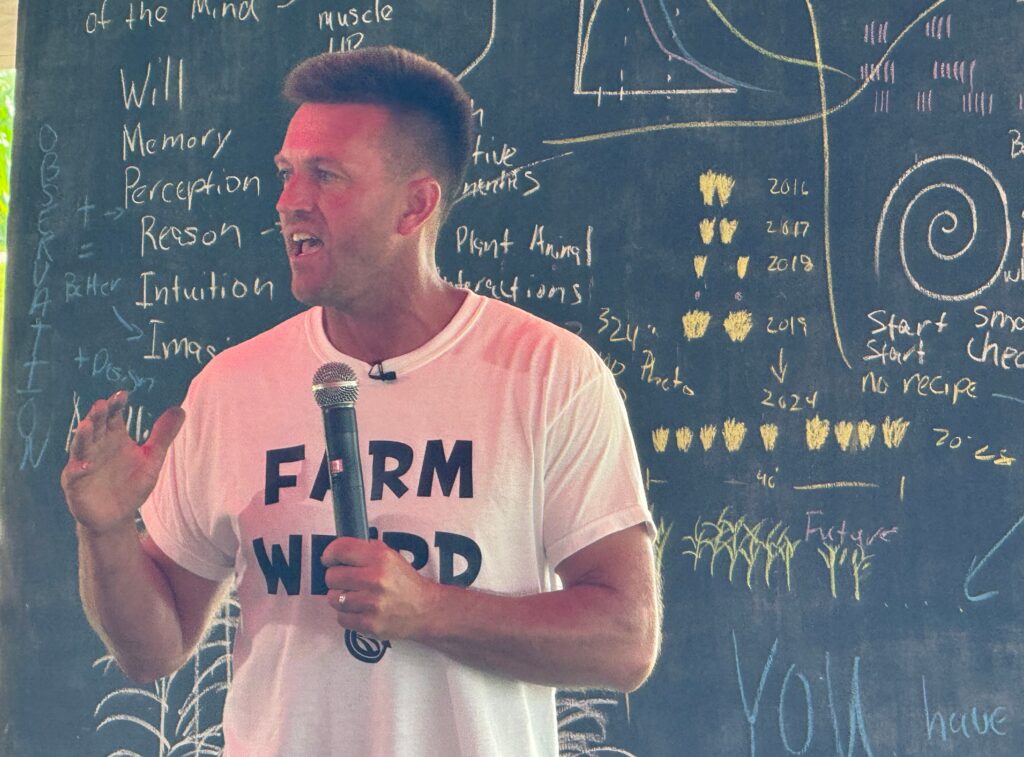
Livestock grazing between corn rows and soybeans growing alongside wheat were just two of the “weird” ways of farming featured at the Acres USA Farm Weird Field Day June 21. The event showcased a tour of planting and grazing experiments host Jason Mauck conducts on his Gaston, Indiana, farm.
CTIC Team members represented DCB, a sponsor, exhibitor, and content creator for the event. More than 200 attendees from several states and Canadian provinces learned from premier speakers, such as John Kempf, founder of Advancing Eco Agriculture, and Gary Zimmer, founder of Midwestern BioAg.
The field day launched filming for the agricultural diversity documentary the DCB Team is working on this summer and fall. This film will feature farmers who are diversifying their operations for improved resilience, risk management, and environmental benefits. Shorter videos will accompany classroom modules on agricultural, economic, ecological, and human diversity. Stay tuned for more progress throughout the summer, as well as release dates for the film, expected in Spring 2026.
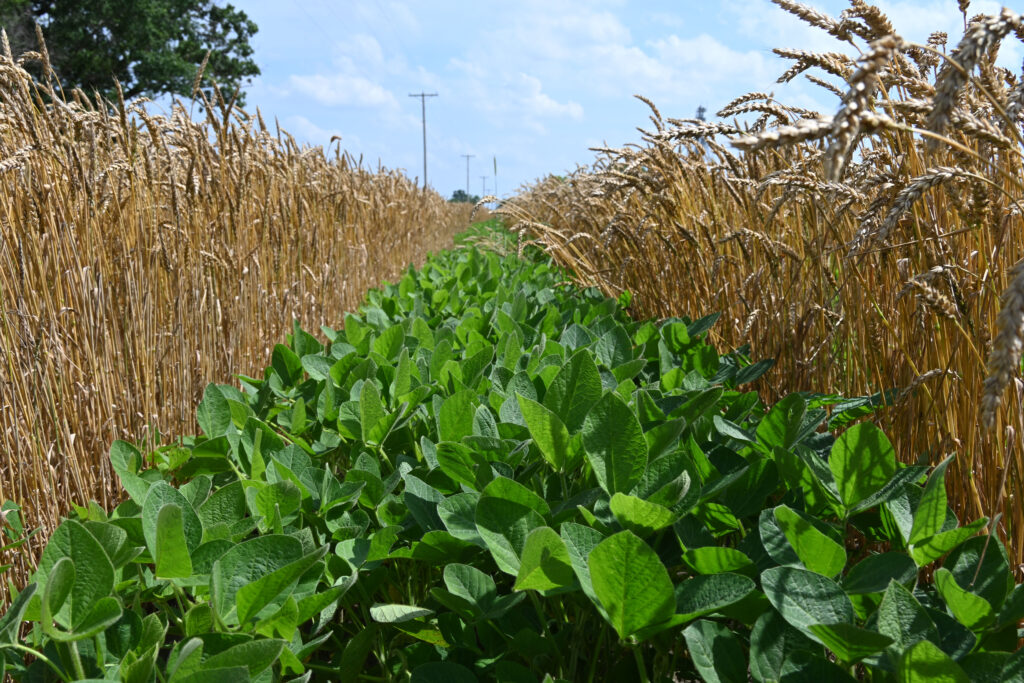
At Farm Weird, our filmmaker captured interviews and Mauck’s farming experiments. In one field, four rows of soybeans were planted between four rows of wheat in a method called relay cropping. The plants reap each other’s benefits with wheat harvested before the soybeans. In a nearby field, corn and cover crops grew in a similar configuration. Known as intercropping, cattle will graze the cover crops in between the corn.
Sheep, goats, hogs, and chickens grazed corn stubble via the StockCropper. This autonomous moving barn fits between standing corn rows and was developed by Zack Smith, an Iowa farmer who works with Mauck on Farm Weird. The animals are housed in the StockCropper, which moves forward autonomously so that the animals can graze new forage. Smith said his goal is to provide families a way to raise their own meat efficiently while lowering the time commitment needed to take care of the animals.
Here are some takeaways from the experts and farm tours at Farm Weird:
- Soil health is wealth.
- Crop diversity builds more productive ecosystems.
- The best system for an operation is found through variability.
- Livestock make cover crops work.
- Experimentation leads to innovation, but ideas need time to percolate. The value of experimenting may not be immediately clear, but the tests can pay off in a meaningful way down the road.
- Symbiosis impacts plant health more than competition. Successful ecosystems need diversity to thrive.
- We have more information today than our grandparents and parents did. If we’re farming the same way they did, only faster, we may be missing something.
Categories

Sign up for our Newsletter
June 2026 | Raleigh, North Carolina
Conservation in Action Tour | America’s Premier On-Farm Experience
Related News

Speakers and Stations Added for Conservation in Action Tour
Regenerative farmers to provide perspectives on circular production systems that scale. This year’s Conservation in Action Tour will feature 10+ innovative farmers, each presenting their own station to broaden perspectives for attendees interested in diverse rotations, profitability of conservation practices, market development opportunities, conservation financing, nutrient management, technology, and data benchmarking and monetization. The 19th annual…

Farm Stops Set for Conservation in Action Tour
Attendees will take a deep dive into the data and technical assistance driving North Carolina’s diverse rotations and cropping systems that include cotton, soybeans, corn, tobacco, strawberries, sweet potatoes, peanuts, and watermelon. Innovation, profitability, and technology in conservation agriculture will take center stage during the 19th annual Conservation in Action Tour June 3-4 in and around Raleigh, N.C. …

Farmer Feedback Needed for the National Cover Crop Survey
Farmers across the U.S.—whether they use cover crops, formerly used them, or have never planted covers—are invited to share their insights on cover crops in the National Cover Crop Survey being conducted by the Conservation Technology Information Center (CTIC), the USDA’s Sustainable Agriculture Research and Education (SARE) Program, and the American Seed Trade Association (ASTA).…